Sign up to view this video
Join Now
Refuge, Rigpa, Visualisation, Trust & Acceptance
Thailand Retreat on Compassion Practices
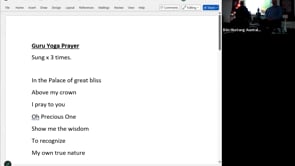
The meeting began with a prayer in English, followed by a discussion about a retreat in Thailand led by Geshi Sohn, which focuses on the four immeasurables: love, compassion, joy, and equanimity. Geshi explained that bodhicitta, or the mind of enlightenment, involves developing a broader perspective of compassion and understanding, moving beyond self-centered concerns to benefit all beings. The retreat aims to cultivate this mindset through practices that emphasize mindfulness and the interconnectedness of all beings.
Tibetan Buddhism's Phowa Practice Explained
Paula explained the role and purpose of Power Practice in Tibetan Buddhism, particularly in relation to the intermediate state (Bardo). She described how practitioners use this practice to maintain a calm mind and transfer consciousness during moments of shock or pain, without resorting to suicide. Paula shared a story about a Tibetan yogi who used Phowa Practice to face death without fear, emphasising that it is not about taking one's own life but about accepting death with a peaceful mind.
Mind-Reading and Rebirth Concepts
Geshi discussed the concept of mind-reading, explaining that while Buddhas and bodhisattvas can read minds, individuals' strong concepts and limited beliefs act as barriers. He emphasized that breaking through these limitations requires recognizing and challenging one's own beliefs, comparing it to the metaphor of a doctor with healing abilities but ineffective if the patient does not trust or accept the treatment. Geshi also touched on the topic of connecting with people who have passed away, noting that most deceased individuals are reborn rather than remaining in an intermediate state, and that some great beings remember their past lives due to heightened awareness and wisdom.
Tibetan Buddhism's Concept of Refuge
Jordan and Geshi discussed the concept of refuge in Tibetan Buddhism, exploring the distinction between inner and outer refuge. Geshi explained that refuge encompasses external elements like the Buddha, Dharma, and Sangha, as well as internal aspects such as one's own awakened awareness and personal development. They discussed how admiration for others can lead to personal growth and the importance of trust in maintaining healthy relationships. Geshi emphasized that trust is fundamental to overcoming doubt and rebuilding connections, both in personal relationships and in the practice of Buddhism.
Understanding Rigpa and Awareness
Sascha and Geshe discussed the concept of Rigpa, or awareness, and its relationship to completing nogdrö practices. Geshe explained that Rigpa is not a single thing to be achieved but rather a continuous awareness that can be developed through both meditation and daily life. He emphasized the importance of maintaining this awareness in all aspects of life, from family and relationships to work and study. Geshe also touched on the concept of a yogi's conduct, which should be different from ordinary conduct and involve using Rigpa in a constant state of awareness.
Visualization Practices in Tantra and Dzogchen
Geshe discussed the differences between visualization practices in Tantra and Dzogchen, explaining that while Tantra involves dualistic visualization and merit accumulation, Dzogchen operates from a non-dualistic state of Rigpa where the mind is in a natural, uncontrived state without subject-object differentiation. They described how in Rigpa, there is no dualistic perception or leveling of experiences, and explained that while the mind can play with various states, there is no actual subject-object relationship in this state.
Navigating Chaos and Finding Balance
Harry, a recent participant, expressed concerns about navigating the current Kali Yuga, particularly regarding global conflict and his difficulty in finding love for the Australian government. Geshe responded by discussing historical perspectives on power and territory, suggesting that while human nature can be chaotic, the modern world has systems like the United Nations to prevent absolute power from causing extreme harm. Geshe recommended focusing on Dharma studies and limiting exposure to news to help maintain compassion and understanding, emphasizing that power is inherently impermanent and that practicing wisdom can help manage these challenges.
Guidance for New Learning Journey
Zac, who is new to the practices discussed, inquired about guidance and direction for his learning journey. The sangha provided encouragement and advice, emphasizing the importance of patience and dedication, especially in balancing new responsibilities with personal practice. A sangha member shared personal experiences and offered reassurance that the current situation is a valuable opportunity for growth and learning.
Balancing Science and Spiritual Growth
The group discussed their spiritual and philosophical approach, emphasizing the importance of balancing science and spirituality to lead a meaningful life. They shared their goal of understanding truth and compassion, regardless of religious beliefs, and highlighted the need to overcome ego and foster trust. The session concluded with a guided meditation and a dedication prayer.